

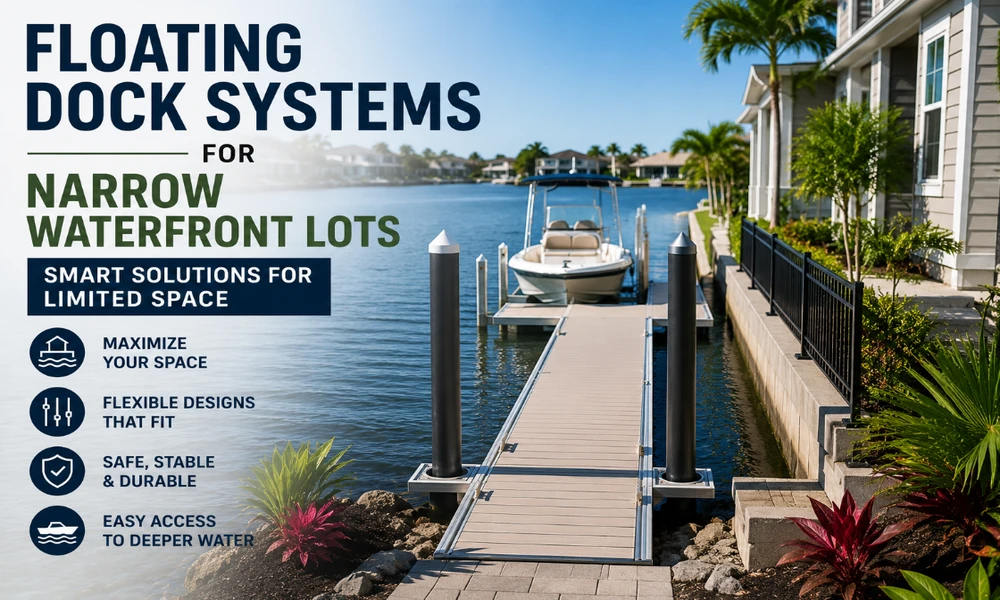
A narrow waterfront lot can make dock planning feel difficult.
There may not be much shoreline to work with. Nearby properties could limit the available space. The water may be shallow near the edge, or the lot may need room for a boat without blocking access.
This is where a well-planned floating dock system can help.
Floating docks can be designed to fit tight waterfront areas while still providing safe and useful access to the water. The key is choosing the right layout, size, and anchoring method for the property.
Start With the Available Shoreline
The first step is measuring the usable waterfront space.
A narrow lot may only allow a small entry point from the shore. That does not always mean the dock has to feel cramped. The dock can extend outward into the water instead of taking up more space along the shoreline.
A straight dock is often one of the simplest options for a narrow property. It creates a clear path from land to deeper water and uses less horizontal space.
The final layout should also consider neighboring docks, property boundaries, and local setback requirements.
Choose a Simple Dock Layout
Complicated dock shapes may not work well on small waterfront lots.
A narrow floating dock usually benefits from a clean and simple design. Common layouts may include:
- A straight walkway with a small platform
- A narrow finger dock beside a boat slip
- A compact L-shaped dock
- A small T-shaped platform at the end
- A modular dock that can be adjusted later
The best design depends on how the dock will be used.
Someone who mainly launches kayaks may need a different setup than a homeowner docking a center-console boat. A small seating area may also require more width at the end of the dock.
Use Space Efficiently
Every section of a narrow dock should have a purpose.
Built-in cleats, low-profile ladders, and compact storage can help reduce clutter. Accessories should not block the walking path or make the dock harder to use.
Vertical storage can also help. Kayak racks, paddle holders, and small equipment mounts may keep gear off the dock surface.
A wider platform at the outer end can create space for boarding, fishing, or sitting without making the entire dock wide.
This approach keeps the main walkway narrow while still adding useful space where it is needed most.
Consider Water Depth and Boat Access
Water depth often affects dock placement.
If the water is too shallow near shore, the dock may need to extend farther out. This can help place the boat in deeper water and reduce the risk of hitting the bottom.
The dock should also allow enough room for the boat to approach, turn, and leave safely.
On a narrow lot, this may require careful planning. The boat slip should not interfere with neighboring property or create a difficult angle for docking.
Wind, current, and tidal changes should also be considered. A dock that looks practical on a calm day may be harder to use when the water is moving.
Select the Right Anchoring System
Floating docks need a secure anchoring system to remain stable.
Common options include pilings, guide poles, stiff arms, cables, and weighted anchors. The best choice depends on water depth, bottom conditions, tides, waves, and local regulations.
Pilings can help keep a dock in position while allowing it to rise and fall with the water. Stiff-arm systems may work well in some protected areas where pilings are not practical.
A narrow dock may experience more movement if it is not supported correctly. Proper anchoring helps reduce side-to-side motion and makes the dock feel safer underfoot.
Keep Safety in Mind
Narrow docks need enough room for comfortable movement.
The walking surface should be slip resistant and free from loose equipment. Handrails may be helpful near steep gangways or in areas used by children, older adults, or guests with limited mobility.
Lighting should also be planned carefully.
Low-profile lights can improve visibility without taking up valuable space. They can be placed along the edges, near steps, and around the boarding area.
Plan for Future Changes
A modular floating dock can be a good option for a narrow waterfront lot.
Sections may be added, removed, or rearranged as needs change. A homeowner might begin with a basic walkway and later add a kayak launch, boat platform, or small seating area.
This flexibility can make the dock more useful over time.
A narrow waterfront property does not have to limit access to the water. With careful measurements, a simple layout, and the right materials, a floating dock can fit the space without feeling crowded.
Good design focuses on what the property truly needs. Sometimes a smaller dock, planned well, works better than a larger one that takes up too much room.
This post was written by a professional at Supreme Marine Floating Docks. Supreme Marine Floating Docks is dedicated to providing top-quality floating docks and marine accessories that combine durability, innovation, and superior performance. While we are a new brand, our team brings over 50 years of combined industry experience, making us trusted marina contractors Palm Beach. We are passionate about designing and delivering products that meet the highest standards, ensuring reliability and longevity in all marine environments. Whether for residential, commercial, or recreational use, our docks are crafted with precision and care, setting a new benchmark in the industry. At Supreme Marine, we don’t just build docks-we create lasting solutions.
